
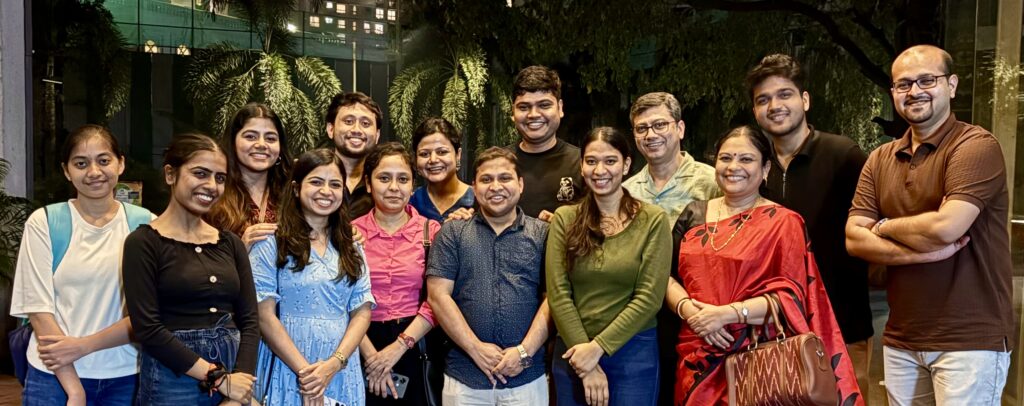
Prof. Banerjee’s research group uncovered an unconventional host defense strategy involving the AAA-ATPase p97 (VCP), a molecular tweezer that rips apart invading bacteria. Employing infection models, advanced imaging, and biophysical approaches, we show that cells not only utilise chemical signals but also apply mechanical force to disrupt bacterial membranes. This pioneering research, supported by Ignite Life Science foundation, provides novel insights into how our body fights lethal infections and opens new avenues for tackling infections in the era of rising antibiotic resistance.
The Problem or the Big Picture
Every moment, we are surrounded by millions of microbes—many of them capable of causing disease. Some of these invaders manage to sneak inside our cells, finding a safe haven away from antibiotics and immune defenses. And yet, despite this constant exposure, we don’t fall sick nearly as often as we should. Is it sheer luck? Not quite. That’s because our cells do not just sit back and relax. They are constantly on guard, engaged in invisible battle—detecting and eliminating these microscopic intruders. Over the years, scientists have studied how cells recognize these invaders, marking them with ubiquitin—essentially a red flag for the cell. But what happens once a bacterium is tagged, remains a mystery. How does a cell eliminate something as large and complex as a bacterium? It was this unanswered question of how recognition culminates in bacterial destruction that drove Prof. Banerjee’s group to uncover the missing piece of the puzzle.
Your Idea / Approach
AAA-ATPases (ATPases Associated with diverse cellular Activities) are motor proteins that use energy from ATP hydrolysis to remodel proteins and molecular complexes. When the team investigated whether any such AAA-ATPases are also involved as mediators between the bacteria and the proteasome, they found that VCP/p97 attaches to tagged bacteria and begins to pull out their surface proteins. Like plucking nails with a crowbar, this gradually weakens the bacterial membrane until it ruptures, leading to the bacterium’s destruction. The group combined microbiology, cell biology and microscopy coupled with animal studies to unambiguously prove that VCP/p97 acts as a tweezer-like nanomachine that plucks out ubiquitin-tagged surface proteins from both Gram-positive as well as Gram-negative bacteria, ultimately rupturing them in the host cytosol.
What it means to the world?
This finding reveals a new layer of intracellular defense, one where mechanical force, not just chemistry or signalling, plays a central role in cell’s innate defence. It opens up exciting possibilities for tackling antimicrobial resistance by harnessing or enhancing the action of these cellular nanomachines. At the same time, understanding how successful intracellular pathogens evade this arm of cytosolic immunity could reveal new vulnerabilities to target them. Thus, this work sets the stage for future studies aimed at translating cellular mechanics into therapeutic interventions.
Selected Publications
Ghosh, S., Roy, S., Baid, N. et al. Host AAA-ATPase VCP/p97 lyses ubiquitinated intracellular bacteria as an innate antimicrobial defence. Nat Microbiol 10, 1099–1114 (2025). https://doi.org/10.1038/s41564-025-01984-y
Apte, S. et al. An innate pathogen sensing strategy involving ubiquitination of bacterial surface proteins. Sci. Adv. 9, eade1851 (2023). https://doi.org/10.1126/sciadv.ade1851
Team Members
- Dr. Anirban Banerjee
- Dr. Sourav Ghosh
- Suvapriya Roy
- Dr. Navin Baid
- Udit Kumar Das
- Sumit Rakshit
- Sudipti Shaw.
Collaborators
Dipshikha Chakravortty
Department of Microbiology and Cell Biology, Indian Institute of Science, Bengaluru, Karnataka, India.
Jagannath Mondal
Tata Institute of Fundamental Research, Hyderabad, Telangana, India.
Roop Mallik
Department of Biosciences and Bioengineering, Indian Institute of Technology Bombay, Mumbai, Maharashtra, India
Sandip Kaledhonkar
Department of Biosciences and Bioengineering, Indian Institute of Technology Bombay, Mumbai, Maharashtra, India