
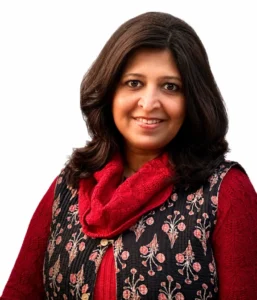
- Subhra Priyadarshini
Chief Editor, Nature India and Global Supported Projects, Nature Portfolio (Springer Nature); British Chevening Fellow; Kavli Prize Media Scholar; Award-winning science journalist
In my science journalism career of three decades, I’ve had the enviable privilege of sitting across the table with remarkable scientists, closely examining their life and work.
Strikingly, my conversations with women scientists have almost always extended beyond experiments and discoveries into mentorship, caregiving, self-doubt, biases, equity and resilience. They have given me a deeper, nuanced understanding of what I call ‘humans of science’ and, of course, forced me to think of what must change for them to feel equal and seen as scientists.
“I see science journalism and communication as having a crucial role in deciding whose stories become part of our collective memory.” Every time we tell the story of a woman scientist as an essential contributor, we expand the imagination of who has agency, who gets to do science, what an ideal scientific ecosystem must look like. I don’t take this responsibility lightly – the responsibility of keeping a record of science for posterity and ensuring these stories are told with the prominence they deserve.
“Visibility is one of the conditions that makes success possible. Young people cannot aspire to what they seldom see”.
India’s women scientists are leaving a mark on global science – and there are so many names in this report alone to draw inspiration from. As a just, diverse, and equitable society, shouldn’t all books, journals, committees, meetings, panels, and leadership positions in institutes reflect this happy reality?