
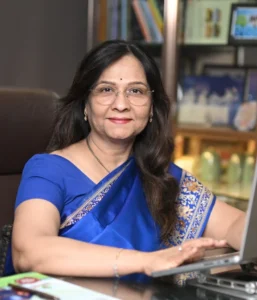
- Sandeepa Kanitkar
Founder Chairperson & Managing Director, Kan Biosys Pvt. Ltd
The Role of Women in Entrepreneurship and Its Impact on Society
Women entrepreneurs have emerged as one of the most transformative forces in the modern global economy. Once confined to the margins of business ownership, women today are founding startups, scaling enterprises, and reshaping industries at an unprecedented pace. Their growing presence in entrepreneurship is not merely an economic milestone — it is a profound social shift with far-reaching consequences.
At its core, women’s entrepreneurship is driven by a blend of necessity and ambition. Many women start businesses to achieve financial independence, balance family responsibilities, or fill gaps in markets that male-dominated industries have long overlooked. This unique perspective gives rise to innovations in healthcare, education, childcare, and social enterprise — sectors that directly improve quality of life.
The economic impact is undeniable. Studies consistently show that when women earn and control income, they reinvest a significantly higher proportion back into their families and communities compared to men. Women-led businesses create jobs, stimulate local economies, and contribute meaningfully to GDP. In developing nations especially, female entrepreneurship is one of the most reliable pathways out of poverty.
Indian women in science and enterprise have been particularly exemplary.
Kiran Mazumdar-Shaw, founder of Biocon Limited, built India’s largest biopharmaceutical company from a small garage startup in Bengaluru. By making insulin and cancer drugs more accessible and affordable, she demonstrated how entrepreneurship can drive both innovation and social impact.
Similarly, Dr. Swati Piramal, Vice Chairperson of Piramal Enterprises, has been a driving force in making cutting-edge pharmaceutical research available to underserved populations in India. Her work spans drug discovery, global healthcare partnerships, and public health advocacy, demonstrating how women leaders can steer science-driven businesses with both commercial acumen and humanitarian vision.
Tessy Thomas, often called the “Missile Woman of India,” broke extraordinary barriers as the first woman to lead a missile project in India — inspiring a generation of women in STEM and defence technology.
The influence of women extends powerfully into politics and bureaucracy as well.
The 73rd Constitutional Amendment (1992), reserving one-third of seats in Panchayati Raj institutions for women, transformed local governance by empowering millions of elected women leaders. V. S. Ramadevi became India’s first woman Chief Election Commissioner, while Nirmala Sitharaman has led the country’s economic policy through challenging times, marking important milestones for women’s leadership in governance.
Vijaya Kishore Rahatkar, the 9th Chairperson of the National Commission for Women, rose from grassroots public service to national leadership. Over three decades, she has championed initiatives for acid attack survivors, women’s safety, legal reforms, digital literacy, and economic empowerment. Through the Anandi Empower Foundation, she continues to advance education, livelihoods, and opportunities for women across Maharashtra.
Women in politics and public administration have played a crucial role in advancing policies on maternal health, education, nutrition, and gender equity, ensuring governance is more inclusive and responsive.
Equally transformative are the stories of women entrepreneurs from India’s villages and small towns. Shri Mahila Griha Udyog Lijjat Papad grew from seven women making papads in Mumbai into one of India’s largest women-owned cooperatives, demonstrating the power of collective entrepreneurship. Barefoot College has empowered rural women to become solar engineers, while the Self-Employed Women’s Association has enabled millions of informal women workers to access credit, markets, and social security.
In Maharashtra, Mahila Arthik Vikas Mahamandal (MAVIM) has strengthened nearly 100,000 self-help groups across thousands of villages, empowering over a million rural women through livelihoods and financial inclusion. Together, these initiatives show that entrepreneurship often begins not in boardrooms, but with women transforming their communities through collective action and opportunity.
Kan Biosys Pvt. Ltd., Pune – which I lead today is recognised as one of India’s most pioneering firms at the intersection of microbiology, agriculture, and technology. As an industrial microbiologist with over 35 years of experience, I have spent my career unlocking the power of microbes to transform Indian agriculture. I founded Krishi Mitra Bioproducts in 1993 — one of the earliest ventures in India’s agri-biotech space — and went on to establish Kan Biosys in 2005, a company today recognized as a leader in microbial products for sustainable agriculture. My first patent, for producing liquid biofertilizers, won the prestigious United Nations WIPO Gold Medal, awarded at the hands of the Vice President of India in 2001 — a recognition that placed Kan Biosys firmly on the global map of agricultural innovation.
Women leaders often foster more inclusive, ethical, and socially responsible organizations. Yet many continue to face barriers such as unequal access to funding, limited mentorship, gender bias, and disproportionate caregiving responsibilities—challenges that are even greater in rural India. Unlocking their full potential requires sustained policy support, greater access to opportunities, and broader societal change.
“Whether founding a biopharmaceutical giant, leading national fiscal policy, transforming village governance, rolling papads on a cooperative rooftop, championing women’s rights from the helm of a national commission, harnessing microbes to revolutionise sustainable farming, or joining an SHG in a Maharashtra village through MAVIM, Indian women have demonstrated time and again that their leadership is not incidental — it is indispensable. From Kiran Mazumdar-Shaw’s laboratories to Swati Piramal in drug discovery, from Nirmala Sitharaman’s budget speeches to Vijaya Rahatkar’s crusade for women’s legal rights, from Ela Bhatt’s union meetings in Ahmedabad to MAVIM’s 10,000 villages, the story of women’s entrepreneurship in India is ultimately the story of India itself — resilient, diverse, and constantly reinventing what is possible”.