
Stories of Science
TnpB: a mini genome editing tool for next-generation crop engineering
The Problem or the Big Picture
Modern agriculture must increase productivity while reducing chemical and other inputs under increasing climate stress, all while minimizing environmental footprints. Genome editing offers a powerful route to achieve these goals by enabling precise and targeted changes in plant DNA. However, the most widely used genome-editing platforms, such as CRISPR-Cas9, are large and technically challenging to deliver into plant cells, particularly through viral vectors. They are also subject to complex international intellectual property landscapes. These IP constraints can limit accessibility in the Global South, including India. This motivated Dr. Molla’s group to explore naturally compact, alternative genome-editing systems that are efficient and free from many of the technological and IP limitations associated with existing tools.
Your Idea / Approach
Dr. Molla’s team turned to TnpB (short for transposon-associated protein B), a tiny DNA-cutting protein naturally found in bacteria and considered an ancient relative of today’s CRISPR tools. Like CRISPR, TnpB can be guided by a small RNA molecule to cut DNA at a chosen location, but it is much smaller—about one-third the size of Cas9. This raised important questions: Could such a small tool work reliably inside complex plant cells? Would plants repair the DNA cuts correctly? How precise would the edits be? And could TnpB be adapted for advanced tasks beyond cutting DNA, such as switching genes on or making single-letter DNA changes? To answer these questions, the team designed TnpB and other components to work efficiently in plants and successfully demonstrated their use in both rice (a monocot) and Arabidopsis (a dicot). They showed that TnpB can edit multiple genes simultaneously, highlighting its flexibility and scalability. Importantly, the researchers also developed TnpB-based tools that can activate genes without changing the DNA sequence and edit DNA one letter at a time, opening the door to highly precise and customizable plant improvement.
Why It Matters?
Smaller genome-editing tools are easier to deliver into cells, simpler to modify, and better suited for next-generation applications. Because of its compact size, TnpB is especially promising for transgene-free genome editing, making advanced tools such as base and prime editors, and delivery through plant viruses.
Currently, introducing genome-editing tools into plant cells often relies on tissue culture methods, which are labour-intensive, time-consuming, and difficult to scale. An attractive alternative is to deliver editing tools using plant viral vectors. However, these viral carriers have strict size limits and cannot accommodate large tools like Cas9. TnpB is small enough to fit into viral vectors, making it possible to achieve tissue-culture-free and transgene-free genome editing, significantly speeding up crop improvement.
These advantages help reduce regulatory hurdles and improve public acceptance of genome- edited crops. Moreover, the grant of a patent on the TnpB genome-editing system to ICAR helps lower intellectual property barriers, particularly for public-sector research and innovation in the Global South. Overall, TnpB enables precise genetic improvement with fewer technical and IP obstacles, paving the way for wider adoption of genome editing in agriculture.
What It Means to the World?
The successful use of TnpB marks a major shift in genome editing—from bulky, complex tools to smaller, more efficient systems inspired by nature. For agriculture, this means crops can be improved more quickly and precisely, leading to higher yields, reduced resource use, improved
nutritional quality, and greater resilience to climate stress.
Selected Publications
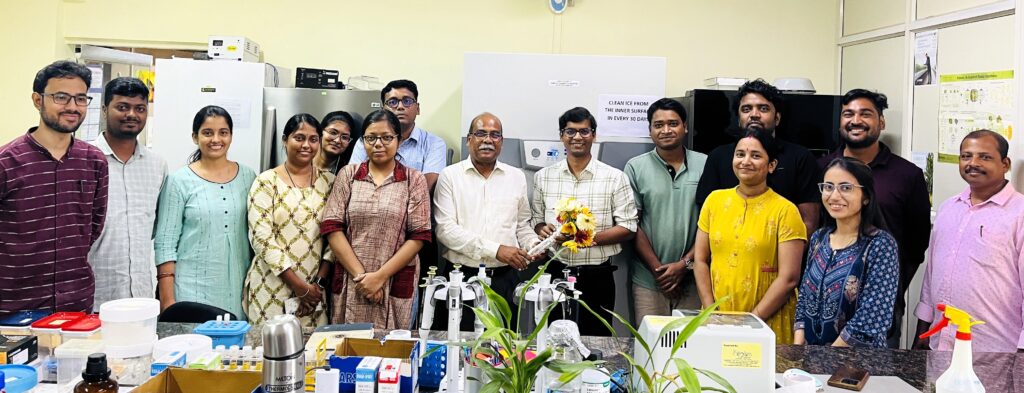
Team Members
Dr. Kutubuddin Molla
Conceived, designed and supervised the project, planned the experiments, analysed the data, wrote the manuscript.
Dr. MJ Baig
Designed and supervised the project, edited the manuscript.
Dr. Subhasis Karmakar
Planned the experiments, performed experiments, analysed data, and wrote manuscript.
Debasmita Panda
Performed experiments, collected data, wrote the manuscript
Sonali Panda, Manswini Das, Romio Saha, Priya Das, SP Avinash, Justin Shih
Performed experiments and collected data
Prof. Yinong Yang and Dr. AK Nayak
Provided guidance and edited the manuscript